

Can I Creqte Lqbels In Q Custo Google Maps Template
Visualize your data on a custom map using Google My Maps
Tutorial Contents
-
Prerequisites
-
Allow'southward Get Started!
-
Import your information
-
Style your map
-
Customize the points on your map
-
Modify the style of your base of operations map
-
Edit your map data
-
Label your data
-
Share and embed your map
-
To share a link to the map:
-
Collaborate with colleagues:
-
Embed your map:
-
More with Google My Maps
-
Search and filter your information
-
Add together points, lines, polygons and directions to your map
-
Employ My Maps on mobile
-
Give-and-take and Feedback
-
What'southward Next
Prerequisites
- No programming skills needed!
- You will demand a Google Business relationship to log in to Google My Maps. Don't have one? Sign up hither.
Let's Get Started!
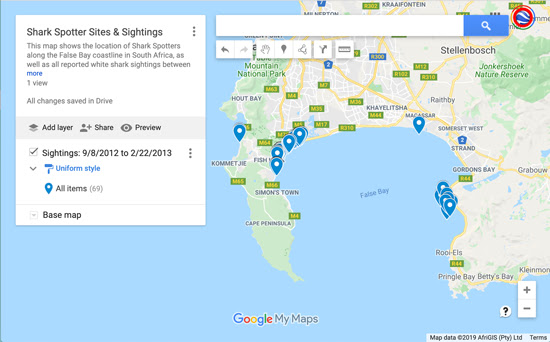
In this exercise, nosotros'll teach you how to import your data, customize the fashion of your map, and share your map. Nosotros'll be using datasets courtesy of The MAPA Projection and Shark Spotters, featuring the locations of Shark Spotters — trained observers watching the h2o for sharks — along the Simulated Bay coastline in South Africa, equally well equally all reported white shark sightings between September 8, 2012, and February 22, 2013. Your finished map will look similar the instance above.
-
Download the two files below, which you will use as sample datasets during this tutorial, and relieve the files to your desktop:
- sharksightings.csv: This file contains reported white shark sightings betwixt September 8, 2012, and February 22, 2013. Includes beach site, appointment, time and location.
- sharkspotter-beaches.csv: This file contains the beach locations where Shark Spotters are stationed, whether it'due south a permanent or temporary Shark Lookout location, and a brusque description.
Import your information
-
Log in to your Google business relationship
-
Go to Google My Maps: https://www.google.com/mymaps
-
In the welcome pop-upward, select Create a new map:
-
Click the text Untitled map to edit the map championship and description. In this case, nosotros've supplied some text below for yous to copy and paste into the Map title dialog box:
Shark Sentry Sites & Sightings -
Now copy and paste the text below into the Description dialog box:
This map shows the location of Shark Spotters along the False Bay coastline in South Africa, also as all reported white shark sightings between September 8, 2012, and February 22, 2013. Shark Spotters are positioned at strategic points along the Cape Peninsula. A spotter is placed on the mount with polarised sunglasses and binoculars. This spotter is in radio contact with another sentinel on the beach. If a shark is seen along the beach, the spotter sounds a siren and raises a specific color-coded flag, upon which swimmers are requested to leave the water. -
In the menu, select Import:

-
Select the sharksightings.csv from your desktop. This volition be the first data layer we upload.
Tip: You can also import a XLSX file or a Google Sheet. You may upload a table containing up to 2,000 rows (see supported data formats and limits here).
-
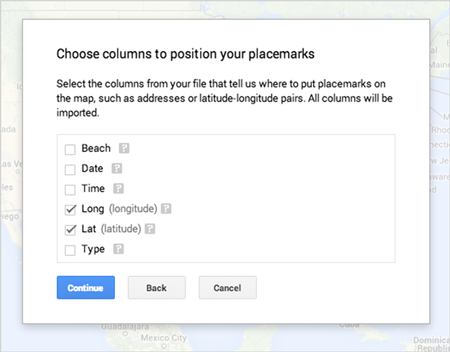
Later on uploading your data, y'all'll be asked to select the column(s) with location information, so that your information volition exist correctly placed on the map (e.g. columns with latitude and longitude data). For this example, select the Lat and _ Long columns_, and hitting Continue. You tin can hover over the question marks to see sample data from that column.
Tip: If you don't take latitude and longitude information, yous can apply addresses in your columns instead.
-
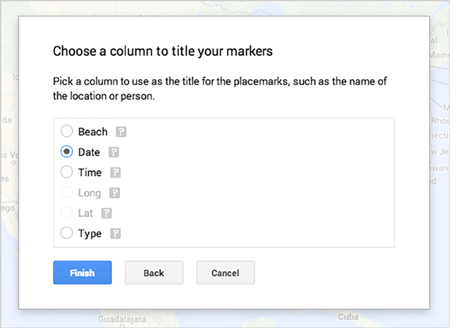
Now pick the column you'd similar to employ to title your markers. For this example, select the Engagement column and hitting Finish:
-
You should at present see your data every bit a layer in the bill of fare, and your points plotted on the map. If you'd similar to modify the proper noun of this layer in the carte, but select the text of the layer name (the default will be the file proper name). For this case, change the layer name to Sightings: 9/8/2012 to ii/22/2013.
-
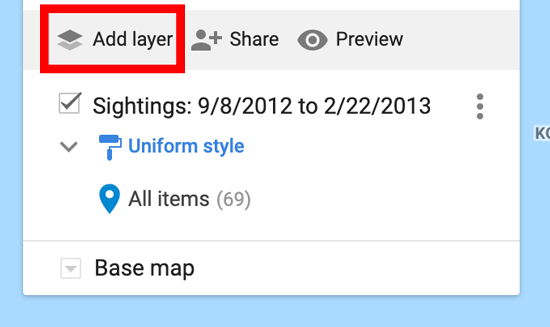
Now let'southward upload the second information layer. Click Add together layer.
Repeat steps half dozen through 9 using the sharkspotter-beaches.csv from your desktop. Select the Lat and Long columns for your location column, and select the Beach Proper noun column to title your markers.
-
You should now see both layers visible in your menu and plotted on your map. Select the text of the layer title, and alter the name to Shark Sentry Beaches.


Next, yous'll learn how to style the points on your map.
Style your map
Customize the points on your map
Start by customizing the Sightings layer, changing the default blue pivot to a shark fin icon.
-
Get to the Sightings map layer in the menu.
-
Hover your cursor over the text All items (69). You should see a pigment can icon announced on the correct. Select the pigment can.
-
Selecting the paint can will pull upwardly a menu of icon choices, including colors and shapes.
-
Select More icons to see several icon shapes you can cull.
-
Under More icons, select the shark fin icon
. Now your blueish pins should be shark fin placemarks on the map.


Side by side, customize the points in the Shark Spotter Beaches information layer. Hither you'll bucket the points into two categories, Permanent Shark Sentry beaches and Temporary Shark Spotter Beaches — data that is already associated with each location in the CSV — and employ two unlike map icons.
-
Click the Shark Picket Beaches layer in the menu and select Private styles.
-
Utilise the Grouping places by drop-downwards menu to select Style by data cavalcade: Type, then choose Categories.
-
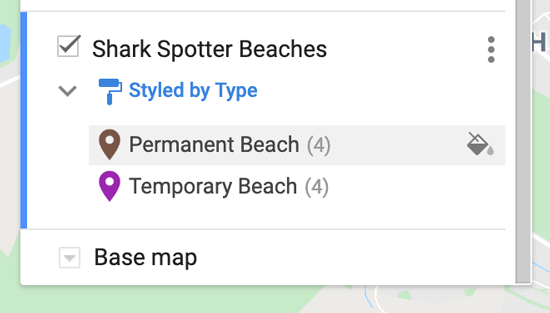
Hover your cursor over the text Permanent, and select the greyness pigment can icon that pops upwardly.
Under More icons, select the man icon
. You should at present run into those icons on your map.
-
Hover your cursor over the text Temporary, and select the gray paint can icon that pops up. Nether More than icons, select the walking man icon
. Y'all should now come across those icons on your map:



Tip: Yous can create and add together your ain icons to the map. Learn more in the Assistance Middle.
Change the style of your base map
-
In the map menu, get to the Base map layer.
-
Select the carat icon to open up a menu of base of operations map styles.
-
Select a thumbnail to change the base map style. For this example, select the thumbnail in the bottom left for Light Landmass.
-
Click anywhere on the map to collapse the base map carte du jour.

Edit your map data
You lot can easily brand changes to your map data at whatsoever point in the map-making process. You may desire to do this if you notice a typo or want to add extra information to your info windows. Below you lot'll learn how to edit your map data.
You've noticed a typo in the Muizenberg data in the Shark Spotter Beaches layer. Shark Spotters is misspelled equally "Shakspotters".

To edit the data:
-
Click the pencil icon in the info window. You can edit the data direct from the info window.
-
Alternately, you lot can make changes to your information from within the data table view. In the Shark Spotter Beaches layer, click the layer menu pulldown, indicated by 3 dots. Select Open information table, and the data table view volition appear:
-
You can brand changes to your data past clicking on any field in the table view:



The tabular array and infowindows for your map locations are synchronized, so any changes you make will be reflected in both places. You can also add rows to your table if y'all want to display boosted information, or delete an existing row.
Tip: If you change the content within a location cavalcade, it will automatically attempt to correct the location co-ordinate to your changes on the map.
Label your information
Y'all can brand labels or "titles" appear adjacent to the features on your map using the Label feature. The label of your feature will be taken from a column in your data that yous specify.
-
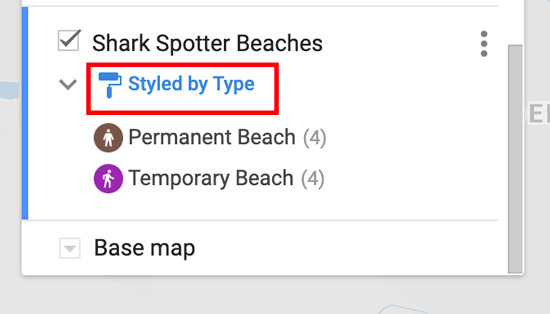
In the Shark Spotter Beaches layer in the carte, click on Styled past type:
-
From the Prepare labels drop-downwards bill of fare, select Beach Name:
-
Now you should run across the points in your Shark Scout Beaches data labeled with its corresponding Beach Name:


Y'all have many options when y'all want to share your map with others. All maps are private by default — but y'all as the creator of the map can view or edit it. Below you'll learn how to make the map public and embed it on your website, besides equally how to collaborate on your map with colleagues.
- Click the Share button in the map menu.
-
Under "Who has admission", select Change and you'll exist given options to either go out the map "Specific people" (or private), "Anyone with the link" or "Public on the web".
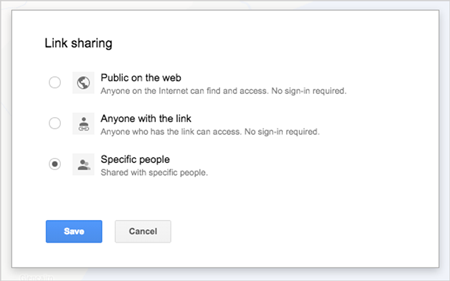
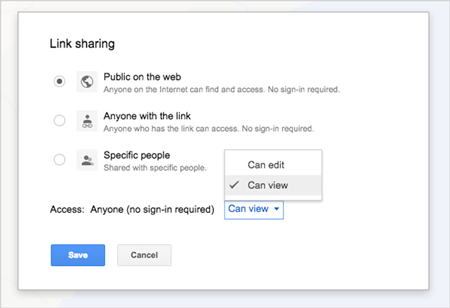
If you choose to make your map Public on the web, you'll be able to further refine your share settings to make your map either just viewable or editable by the public.
Tip: Sharing your map with a person who has a non-Google account? Copy the map URL and change the word "edit" in the URL to "view" before sending -- so no login volition be required.
Collaborate with colleagues:
- Click the Share button in the map bill of fare.
-
Under "Add together people" at the bottom of the menu, type in the e-mail addresses of the people yous'd like to share your map with directly, or choose from your contacts. You lot tin select whether the people you invite tin can edit the map or just view it.

Tip: Y'all tin can quickly add multiple collaborators to your map by sharing your map with a Google Group. Each fellow member of group volition accept access to your map, and if you add new people to the group, they'll have access too.
Embed your map:
- Outset, brand sure your map is Public on the spider web. Share button > Who has access > Change > Public on the spider web > Salvage.
- Go back to your map and select the map menu pulldown, indicated by three dots next to the Share button.
- Select Embed on my site.
-
Copy the HTML and paste it into the source code of your website. Note that you lot tin customize the height and width of your map.

Tip: You lot can set up a default view for the map. This gives you actress control over what portion of the map volition be on display when a viewer first visits your map. To set up this feature, position the map in your browser. Then go to the map menu pulldown, indicated past three dots next to the Share button, and select Ready default view.
Congratulations! You lot take learned how to import information, customize styles and share your map using Google My Maps.
More with Google My Maps
Search and filter your data
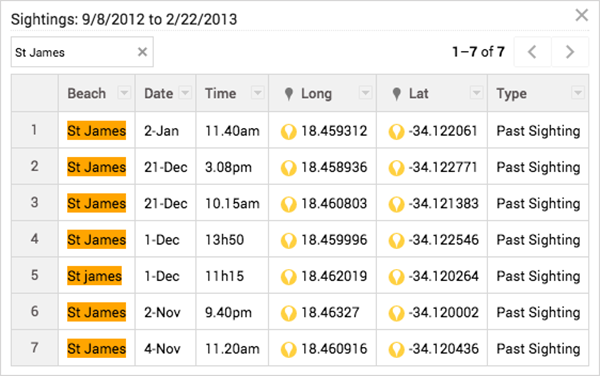
In the Sightings layer, get the layer bill of fare pulldown, indicated by iii dots, and select Open data tabular array:

Use the search box to search and filter through this data:
Add points, lines, polygons and directions to your map
Hand-draw points, lines and polygons on your map with the drawing tools. Click the mitt icon to terminate drawing. You can also relieve driving, bicycling or walking directions to the map. Utilise the ruler icon to measure out distances and areas.

Utilize My Maps on mobile
At that place are many means you can access and edit My Maps on the go: view and edit maps in the My Maps app; view and edit maps on your mobile browser; or just view them in Google Maps for mobile.

Word and Feedback
Have questions about this tutorial? Desire to give the states some feedback? Visit the Google Globe Help Community to discuss it with others.
What'south Side by side
- Go to related Assistance articles to learn more about Google My Maps..
- See all tutorials.

Can I Creqte Lqbels In Q Custo Google Maps Template,
Source: https://www.google.com/earth/outreach/learn/visualize-your-data-on-a-custom-map-using-google-my-maps/
Posted by: shiverbegfring.blogspot.com
0 Response to "Can I Creqte Lqbels In Q Custo Google Maps Template"
Post a Comment